Accurately Dating the Māori Past Using Marine Shell
Published 21 August 2025
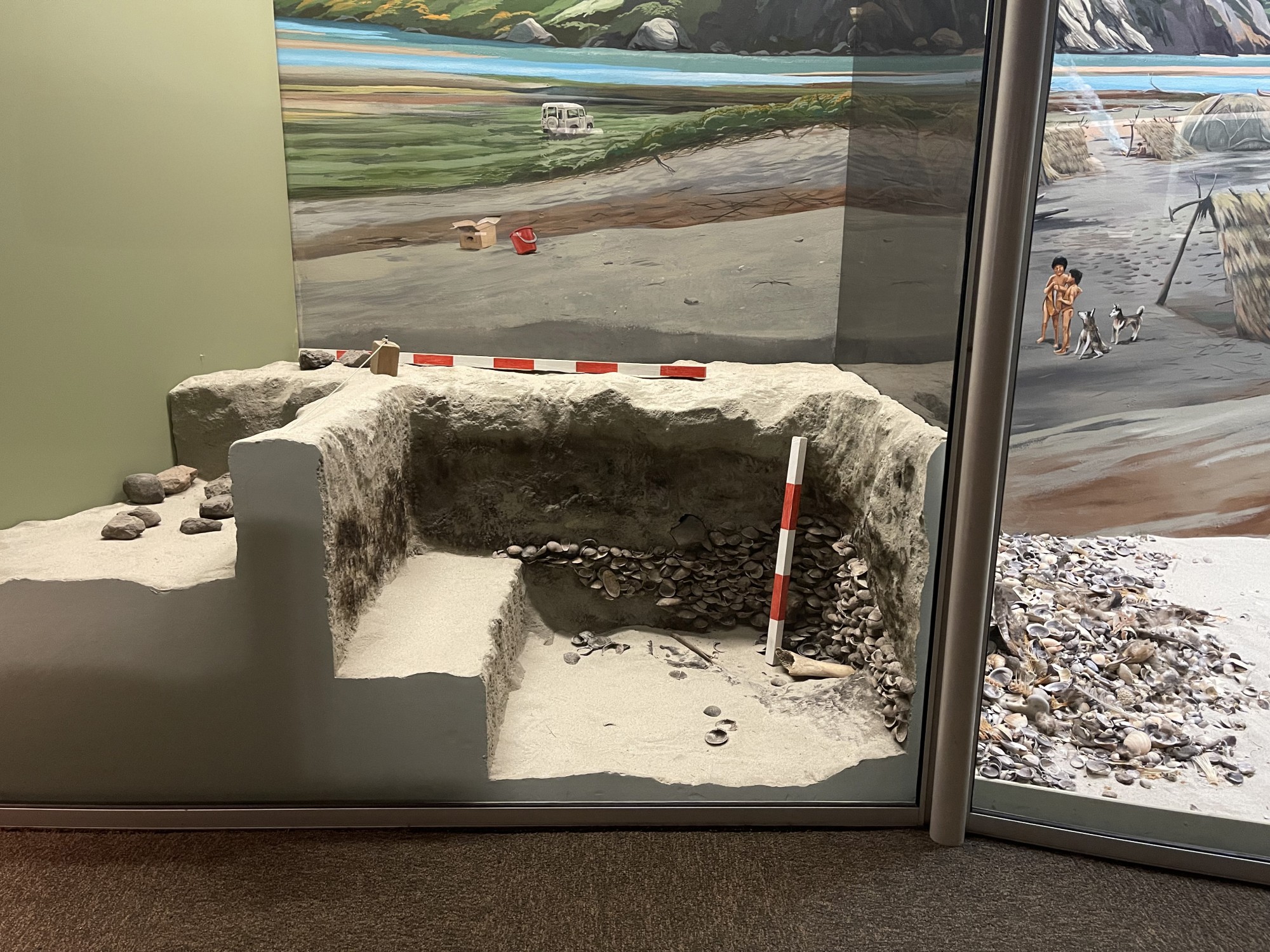
Developing a new local marine calibration curve will bring a whole new level of accuracy and confidence to radiocarbon dating the Māori past, using what is perhaps the most common feature of Māori archaeological heritage – the ancient rubbish heaps of shell middens.
Kaupapa
Precise and accurate radiocarbon (14C) chronologies are essential for clearly dating archaeological events during the 750 years since Polynesian explorers first settled New Zealand. However, because marine life absorbs radiocarbon differently from terrestrial life, dates need to be calibrated to account for that disparity.
The global marine calibration used until now isn't as accurate as we'd like for New Zealand, but an investigation of marine 14C variability around New Zealand has now given us the first temporal 14C marine model for the South Pacific. We aim to apply this new knowledge to wāhi tūpuna from around the country to better align archaeological findings with historical traditions.
Supported by the Marsden Fund through the Royal Society Te Apārangi, this project is led by Fiona Petchey of the University of Waikato's Radiocarbon Dating Laboratory. Collaborators include archaeologists Louise Furey, Magdalena Schmidt, Atholl Anderson (Ngāi Tahu) and Gerard O'Regan (Ngāi Tahu and Curator Māori, Tūhura Otago Museum).
Museum Collections
To achieve the goal, we need to increase the number of precisely dated early Māori sites. Terrestrial (bird bone and charcoal) and marine (fishbone and shell) samples from archived collections in museums will help provide the samples for testing. Both the marine and terrestrial samples must have been found in the same archaeological context, with several pairs collected across multiple layers within a site.
What We Know So Far
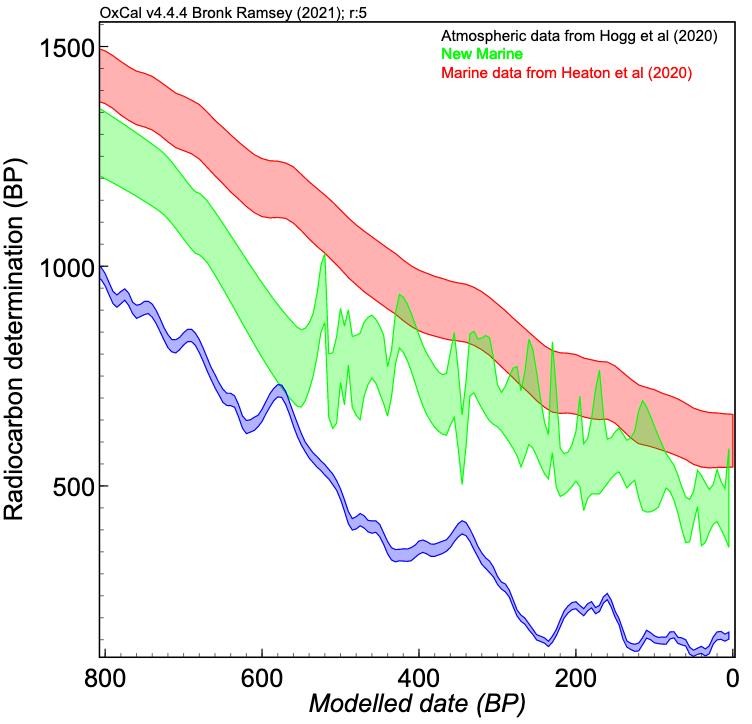
Radiocarbon dating uses the 14C content of organic materials such as charcoal, shell, and bone to work out how old an object is. However, it is essential to understand how 14C has changed over time in our atmosphere and ocean before a calendar age can be calculated (Fig. 1). Its ability to record change over time makes 14C a valuable tool for investigating the past environment and past human activity.
Analysis of over 2200 legacy dates from around New Zealand has highlighted a difference between ocean and atmospheric 14C signals, most notably an extreme shift in ocean values between AD 1350 (650 cal BP) and AD 1400 (550 cal BP). This previously unrecognised change in ocean 14C reflects the onset of harsher climate conditions and coincides with economic change.
Improved Resolution
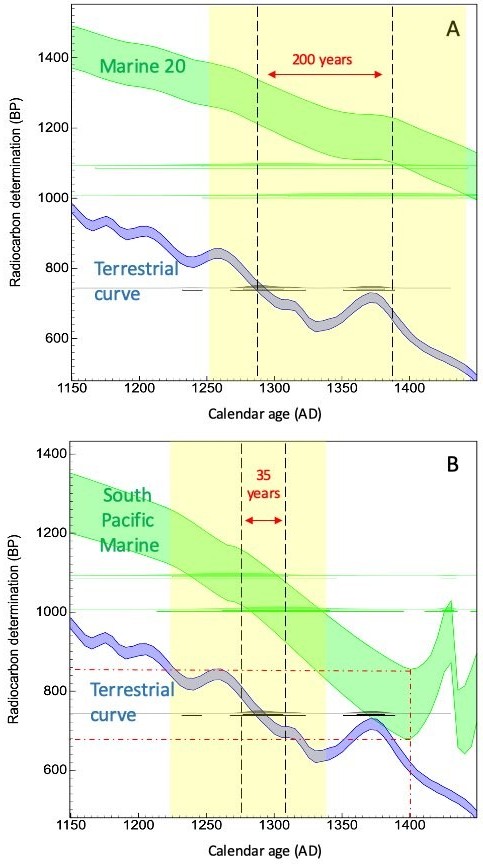
Using both marine and terrestrial samples, it is now possible to separate archaeological sites otherwise assigned to the broad 14th century AD 'settlement' phase (Fig. 2). This new temporal precision will enable us to explore critical questions about Māori settlement and cultural development as society evolved and adapted to a unique environment and changing temperate climate. It will also allow us to investigate voyaging feasibility and connection with communities in central East Polynesia. Already, patterns are beginning to emerge, but so much more is achievable.
Radiocarbon Dating
The sampled materials will be carefully cleaned and converted to CO2 then to graphite. This target is inserted into an accelerator mass spectrometry (AMS) system, where 14C is measured. These high-precision dates (i.e. 700±20 14C years) will be more precise than previous dates. Ultimately, our goal is precision comparable to a human generation. We will also measure the change in stable isotopes (δ18O, δ13C, and δ15N). The δ13C value of marine shell predominantly reflects water source, while δ18O records change in salinity (less saline waters are typically terrestrial in origin) and past temperature. In bone, δ13C and δ15N give us an insight into the animal's diet.
Improved dating of marine-derived material, especially shell, the most ubiquitous material in coastal middens, will dramatically increase the potential contribution of thousands of ancestral sites to our history. The information gained will provide a more detailed template of change that can be used to explore both the visible footprint and Māori world views.
See also the project description on the Marsden Fund, Royal Society Te Apārangi website: https://www.royalsociety.org.nz/what-we-do/funds-and-opportunities/marsden/awarded-grants/marsden-fund-highlights/2021-marsden-fund-highlights/using-marine-shells-to-accurately-locate-early-maori-settlers-in-time
